The Phases of Doing Well
Recently someone I'm close to was going through something hard. When a friend asked how she was doing, I paused and thought about it. She was showing up in all the ways that mattered — following her treatment plan, keeping commitments, doing what needed to be done.
I found myself saying: "She's doing well at not doing well."
It was true. She wasn't well — but she was handling the unwellness better. The usual language failed me. "She's doing well" would have dismissed the enormity of what she was facing. "She's not doing well" would have erased all the strength and effort she was showing.
That moment made me realize we need better language for healing — because it doesn't happen the way we talk about it.
We often talk about healing like it's linear — as though we should move from struggle to insight to breakthrough to thriving in one smooth, upward progression. Most of us know intellectually that healing doesn't work like that, but we don't always have clear language to frame it well for ourselves or our clients. It's layered, cyclical, and non-linear by design.
While research does support a general trajectory of survival → stabilization → growth → integration, the nervous system doesn't move through these stages in a neat sequence. We rotate through them depending on stress load, environment, relationships, identity shifts, and life transitions.
So rather than thinking about healing as something we progress through, I think about it as capacity building — the gradual expansion of how much life, emotion, intimacy, responsibility, or joy we can hold without becoming overwhelmed.
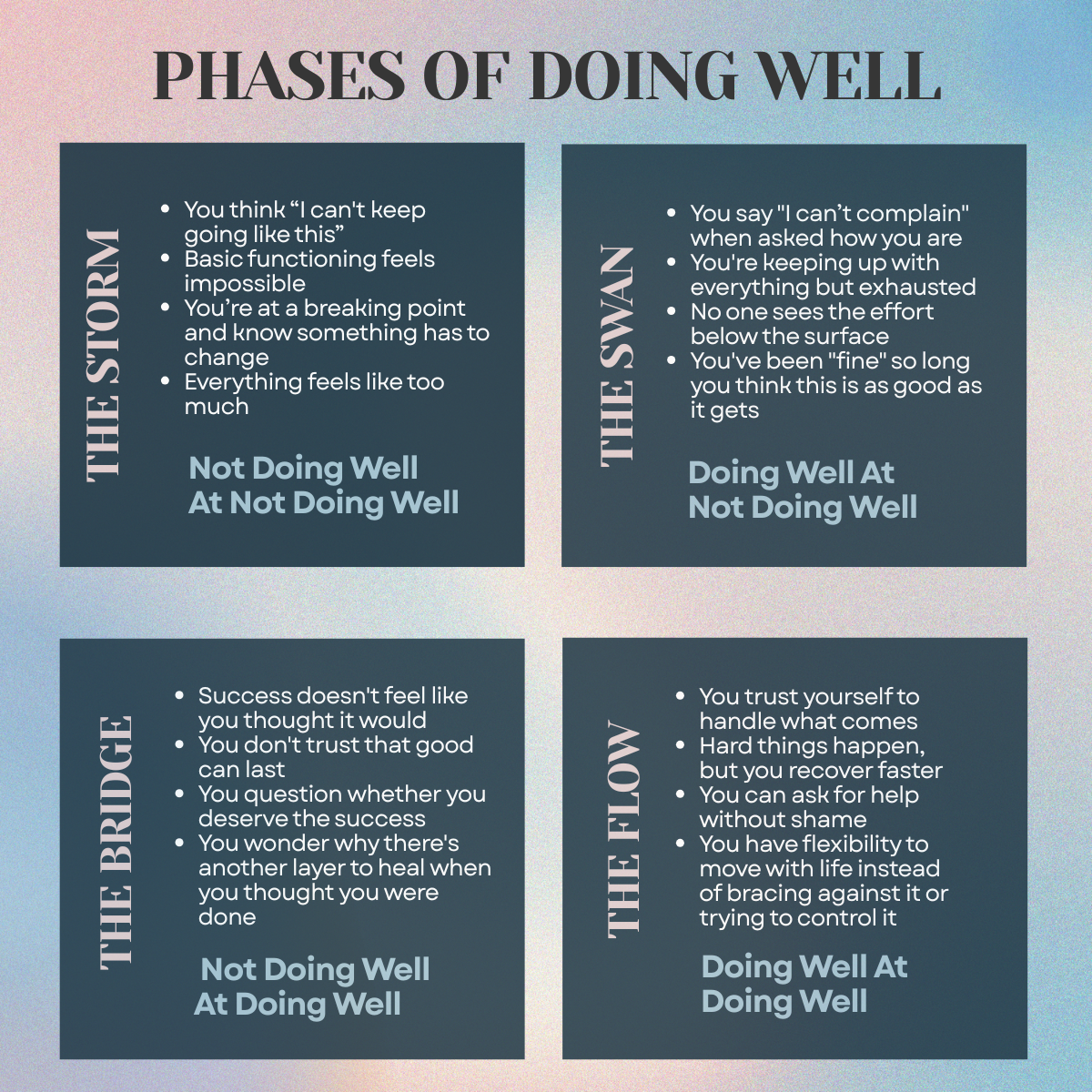
That's where this four-phase framework comes in. It maps two dimensions: how you're actually doing internally (your nervous system state, your capacity, what's happening beneath the surface) and how well you're functioning externally (whether you're showing up, managing responsibilities, appearing "together"). Understanding the gap between them helps you see where you really are.
This isn't a hierarchy or a performance metric. It's a map of states — each with its own needs, patterns, and possibilities. The goal isn't to stay in one phase forever but to recognize where you are today and respond with compassion rather than judgment.
Not Doing Well at Not Doing Well
The Storm — "I can't keep going like this."
This is the crisis place — emotionally overwhelmed, exhausted, shut down or spun up. The nervous system is in full survival mode, operating outside what Dan Siegel calls the Window of Tolerance, the range in which we can regulate emotions and respond flexibly.
This is often where people first seek outside help. It reminds me of something my very first clinical supervisor told me over 20 years ago: change happens when the pain of staying the same outweighs the pain of change. The Storm is that tipping point — when the cost of continuing as you are becomes unbearable, when you can no longer avoid it, ignore it, or push through.
The work in this phase is not mindset or motivation. The work is safety, stabilization, grounding, and support. Healing work often begins here, focused on helping your system find enough ground to stand on.
Doing Well at Not Doing Well
The Swan — "I can’t complain.”
Here, things look functional on the outside — you're working, caregiving, showing up — but internally the system is still bracing. This is high-functioning survival, the place Bessel van der Kolk describes when he says people can look "fine" while still living from hypervigilance or collapse. You're managing, but you're struggling. Coping is happening. But healing hasn't occurred yet.
This phase is often where healing work shifts toward deeper repair, helping someone move from holding it together to actually feeling supported from the inside.
But The Swan can also become a trap. Because it looks like success from the outside, people — especially over-functioners — can spend years here. No one can see the work happening below the surface, the constant effort to keep up the appearance. What looks like a graceful glide actually requires a lot of effort. When the struggle goes on long enough, it stops feeling like struggle at all — it just becomes normal. You're working hard but not going anywhere, managing beautifully while burning out slowly. The external calm masks the internal cost, and because nothing looks broken from the outside, nothing changes. Without awareness or intervention, this chronic state can lead to collapse back to The Storm.
Whether you move through The Swan or stay depends on recognizing you're in survival mode. But that recognition is hard when everything looks fine from the outside.
Not Doing Well at Doing Well
The Bridge — "Why am I anxious when things are finally good?"
Growth is happening — but it feels uncomfortable. This is where someone might say, "Why am I anxious now that things are finally good?" or "Why am I doubting this?" or "Why do I want to retreat just as things start to work?"
This is not sabotage. This is unfamiliarity. The nervous system hasn't yet learned that "good" is safe.
Stephen Porges' Polyvagal Theory explains how even positive experiences like love, success, or visibility can trigger old protective responses until the body learns to tolerate openness. In The Bridge phase, things ARE genuinely better — but that's exactly what makes it destabilizing. There's a space that opens up, a pressure that releases, and it's unfamiliar. Your nervous system knows how to handle crisis, problems to solve, vigilance. Ease feels like a trap. We talk all the time about how people pick what's familiar even when it's not good for them — this is why.
The Bridge is about building trust with yourself that this is real. You need reps. Situations will come up that test you, and you'll notice your own growth. You'll recognize it: "Huh, I didn't collapse like I used to." Your nervous system slowly starts to believe this isn't a fluke. This phase takes time because you need to gather enough evidence — through lived experience, not positive thinking — that the change is sustainable.
This is also a phase where deeper layers surface. You've healed enough to access what was buried. The fact that more is coming up is proof you're ready for it — but it can feel like failure. "I thought I was done." "Why is there MORE?" "Everyone else heals faster than me." The self-judgment turns progress into evidence of being broken, when really, you couldn't have accessed that deeper layer until you'd built enough capacity to hold it. The work in The Bridge isn't just learning to trust that good is safe — it's learning to meet your own unfolding with curiosity instead of criticism.
Imposter syndrome lives here too. You got the promotion, the recognition, the success. Externally, you ARE doing well — the achievement is real. But internally: "I'm a fraud. They're going to figure out I don't belong here." Your system is calibrated for struggle, for proving yourself, for not-quite-enough. So when you arrive at "enough" or even "more than enough," alarm bells go off. The imposter thoughts are asking: Is this real? Can I trust this? Do I actually belong in this good thing?
This is where healing work becomes transformative, helping you learn to hold more without collapsing or contracting. The Bridge is the unsexy, overlooked phase between keeping up appearances and sustainable thriving. You can't skip it.
Doing Well at Doing Well
The Flow — "I can handle this"
This is integration, regulation, capacity — not because life is perfect, but because your system trusts you can meet life as it comes. Research on resilience shows that resilience isn't a personality trait but a trainable capacity.
The Flow isn't the absence of stress or struggle. Hard things still happen. You still get stressed, sad, angry, overwhelmed. But you don't stay flooded as long. You have more choice in how you respond. You trust yourself to handle it, you can ask for help without shame, and you recover faster. This is not about never getting dysregulated but about having the flexibility to move with what life brings without getting stuck. This is sustainable wellbeing.
And even from here, you can cycle back through other phases when life brings major stressors — grief, transition, trauma. The Flow doesn't make you immune. It means you have more internal resources to work with when the hard stuff comes.
How We Move Between Phases
We move through these phases over and over again — across seasons, relationships, life changes, stressors, and expansions. You might spend years in The Swan before recognizing you're holding it together rather than healing. A single crisis can drop you from The Flow back to The Storm. Growth often requires passing through The Bridge's discomfort. And sometimes you're in different phases in different areas of life — flowing at work while in the storm in your relationship.
There is no "right phase" to be in. Each one asks for a different kind of care. The Storm needs safety and soothing. The Swan needs release and repair through healing work and somatic practices. The Bridge needs capacity building — learning to tolerate more, to receive, to meet yourself with curiosity instead of judgment. The Flow needs nourishment and maintenance, the pleasure and depth that sustain wellbeing over time.
The goal is not to chase The Flow at all costs. The goal is to meet your nervous system where it is today — with compassion, with awareness, with choice. That is healing.